
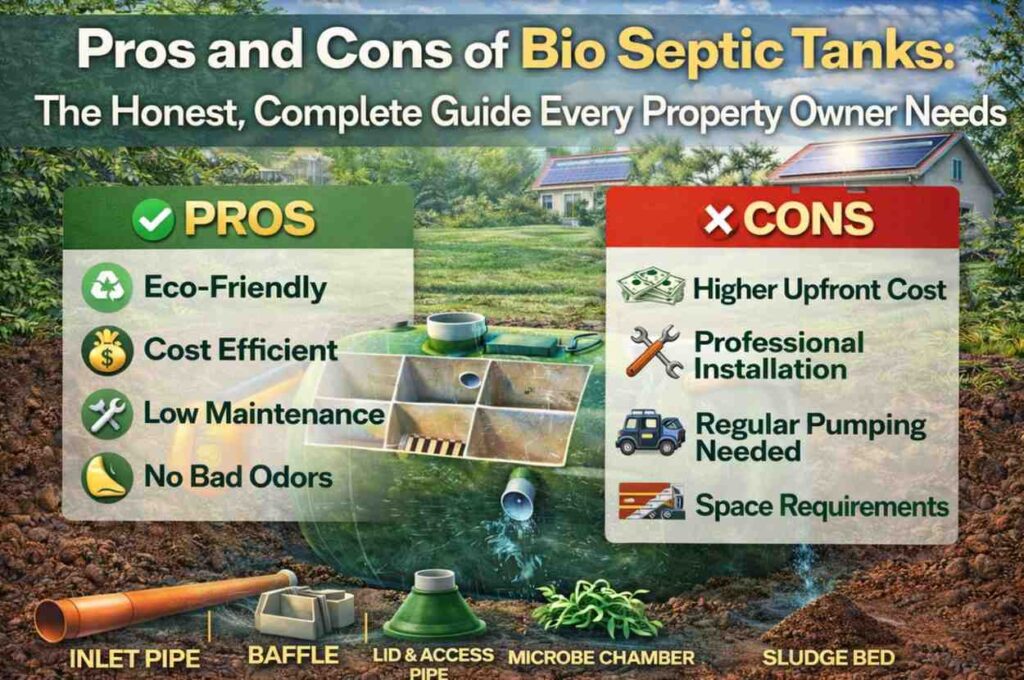
You’ve probably heard the pitch. Bio septic tanks are cleaner, greener, smarter, and better for the environment than conventional systems. And honestly? A lot of that is true. But nobody selling you a bio septic tank is going to walk you through the disadvantages, the maintenance demands, the sensitivity of the biological process, or the situations where a conventional system might actually serve you better.
This guide is not a sales brochure. It’s a balanced look at the real-world advantages and disadvantages of bio septic tanks so you can make a practical, informed decision based on your property, budget, and long-term plans.
What Is a Bio Septic Tank?
A bio septic tank is an on-site wastewater treatment system that uses living microorganisms — primarily bacteria — to break down sewage. Unlike a conventional septic tank that mainly separates solids through gravity, a bio septic system actively treats wastewater through biological digestion.
The result? Cleaner effluent, reduced sludge buildup, and improved environmental performance.
Bio septic systems generally fall into two categories:
-
Anaerobic systems – operate without oxygen, simpler, no electricity required
-
Aerobic systems (ATUs) – use air pumps to supply oxygen, faster treatment, higher effluent quality
Both improve treatment compared to conventional tanks, but aerobic systems require more maintenance and power.
The Pros of Bio Septic Tanks
1. Superior Wastewater Treatment
Bio septic tanks significantly outperform conventional systems in treatment quality. They typically achieve:
-
85–95% BOD reduction
-
80–90% TSS reduction
-
Higher pathogen reduction
-
Lower nitrogen and phosphorus discharge
This means cleaner water leaving the tank and less strain on the drain field.
2. Longer Drain Field Lifespan
Because the effluent is cleaner, the drain field clogs more slowly. Conventional systems often require drain field replacement after 15–20 years. Bio systems can extend that lifespan to 25–35 years.
Avoiding even one drain field replacement can offset much of the higher upfront installation cost.
3. Reduced Sludge Accumulation
Active bacterial digestion reduces sludge buildup by roughly 40–60% compared to conventional tanks. That translates to:
-
Less frequent pumping
-
Lower long-term maintenance costs
-
More stable system performance
Most bio septic tanks require pumping every 3–5 years rather than every 2–3 years.
4. Better Odor Control
A properly functioning bio septic system produces significantly fewer odors. Aerobic systems, in particular, break down odor-causing compounds more completely than traditional septic tanks.
When odors do appear, they often signal a maintenance issue rather than normal operation.
5. Environmental Benefits
Bio septic tanks reduce groundwater contamination risk and lower nutrient loading in nearby water bodies. For properties near lakes, rivers, or environmentally sensitive areas, this improved treatment can be essential for regulatory compliance.
In many regions, biological treatment systems are increasingly required under modern wastewater regulations.
6. Future-Proofing Against Regulations
Environmental standards for wastewater discharge are tightening globally. Bio septic systems are better positioned to meet current and future compliance requirements.
For property owners planning long-term ownership, this can prevent costly forced upgrades later.
The Cons of Bio Septic Tanks
1. Higher Upfront Cost
The most obvious disadvantage is installation cost. Conventional systems may cost ₹2,50,000–₹6,50,000, while bio septic systems often range from ₹6,50,000 to ₹20,00,000 or more, depending on system type and site conditions.
Additional expenses may include:
-
Electrical installation for aerobic systems
-
Control panels and alarms
-
Permit and inspection fees
-
Engineering design approvals
For some property owners, this cost difference is significant.
2. Biological Sensitivity
Bio septic tanks rely on living bacteria. These microorganisms can be disrupted by:
-
Bleach and antibacterial cleaners
-
Antibiotics
-
Harsh drain cleaners
-
Paint and solvents
-
Excess grease
When the bacterial colony is disrupted, treatment efficiency declines. Recovery can take several weeks.
This means owners must adopt more careful household habits.
3. Mechanical Complexity (Aerobic Systems)
Aerobic treatment units contain mechanical components such as:
-
Air pumps
-
Diffusers
-
Float switches
-
Control panels
These components have finite lifespans and require periodic replacement. Mechanical failures can temporarily reduce treatment quality until repaired.
Conventional systems, by comparison, have very few moving parts.
4. Electricity Dependency
Aerobic systems require continuous electricity. During power outages, treatment efficiency declines if oxygen supply stops for extended periods.
While short outages typically cause minimal damage, long outages may require recovery time for bacterial populations.
Anaerobic systems avoid this issue but may produce slightly lower effluent quality.
5. Ongoing Maintenance Requirements
Bio septic systems generally require:
-
Annual professional inspections
-
Effluent testing (in some jurisdictions)
-
Scheduled pump-outs
-
Mechanical component checks
Maintenance costs are typically higher than for conventional systems. Owners must stay consistent with servicing to maintain performance.
6. Seasonal Occupancy Challenges
Bio septic systems perform best with consistent wastewater flow. Holiday homes or seasonal properties can experience bacterial dormancy during long vacancy periods.
Restarting the system may require reseeding and several weeks to return to optimal performance.
Bio Septic Tank vs Conventional System: Quick Comparison
|
Factor |
Conventional |
Bio Septic |
|---|---|---|
|
Treatment Quality |
Moderate |
High |
|
Upfront Cost |
Lower |
Higher |
|
Drain Field Life |
15–20 years |
25–35 years |
|
Sludge Accumulation |
Higher |
Lower |
|
Mechanical Parts |
Minimal |
Moderate (aerobic) |
|
Regulatory Compliance |
Decreasing acceptance |
Increasing acceptance |
Is a Bio Septic Tank Worth It?
For most year-round occupied properties, especially those near environmentally sensitive areas, a bio septic tank offers clear long-term advantages.
However, it may not be ideal for:
-
Tight budgets
-
Seasonal or rarely used properties
-
Owners unwilling to follow maintenance guidelines
The decision ultimately depends on regulatory requirements, long-term ownership plans, and willingness to manage the system properly.
Final Thoughts
Bio septic tanks are neither a miracle solution nor an unnecessary luxury. They are a more advanced wastewater treatment option that delivers measurable environmental and operational benefits — provided they are installed correctly and maintained consistently.
The pros are real. The cons are also real.
Understanding both sides allows you to make a decision based on facts rather than marketing claims.
FAQS
The bio septic tank advantages over conventional systems are substantial — and they compound over time in ways that make the initial cost premium look increasingly reasonable the longer you hold the property.
The most significant advantage is treatment quality. A well-functioning bio septic tank reduces BOD (Biochemical Oxygen Demand) by 85–95%, compared to just 40–50% in a conventional settling tank. That's not a marginal improvement — it's a fundamental difference in how thoroughly the system treats wastewater before it reaches your drain field or the surrounding environment. Pathogens, suspended solids, and dissolved organic compounds are all reduced dramatically compared to what leaves a conventional system.
That treatment quality advantage drives the second major benefit: extended drain field lifespan. The drain field is the most expensive component of any septic system to replace — costs range from $5,000 to $20,000 depending on size and site conditions. Conventional system effluent is the primary cause of drain field failure, as poorly treated water promotes rapid biomat formation that clogs soil pores over 15–20 years. Bio septic effluent, being dramatically cleaner, extends drain field life to 25–35 years in many cases. That single avoided replacement event can more than offset the bio system's upfront cost premium.
Reduced sludge accumulation is another practical advantage that most homeowners underestimate before they experience it. Active biological digestion in the bio-reactor chamber continuously breaks down organic solids, reducing sludge accumulation by 40–60% compared to a conventional tank. The practical result is less frequent pumping — every 3–5 years rather than every 2–3 years — and lower lifetime maintenance costs.
Environmental performance is where bio septic tanks genuinely set themselves apart from conventional alternatives. Lower groundwater contamination risk, reduced nutrient loading to surrounding watercourses, suitability for installation near ecologically sensitive zones, and compliance with increasingly strict discharge regulations all flow directly from the superior treatment quality. For properties near rivers, lakes, or in designated water catchment areas, these environmental advantages aren't just desirable — they're legally required.
Finally, odor control in a properly functioning bio septic system is meaningfully better than in a conventional tank. Aerobic biological treatment produces fewer odor-causing compounds, and effective ventilation design disperses what gases are produced safely away from living areas. A well-maintained bio system should be essentially odor-free at ground level — something very few conventional systems can consistently claim.
The core message here is that the bio septic tank advantages aren't theoretical — they're measurable, documented, and practical. The system treats wastewater better, produces less sludge, extends drain field life, reduces environmental impact, and controls odor more effectively. Every one of these benefits is real and delivers value over the life of the system.
Honest bio septic tank disadvantages deserve as much attention as the advantages — and there are several that are genuinely significant rather than minor inconveniences.
The upfront cost is the most immediately obvious disadvantage. A conventional septic system installation typically costs $3,000–$8,000. A comparable bio septic tank system runs $8,000–$35,000+ depending on system type, size, tank material, site conditions, and permitting requirements. That gap is real, it matters to many homeowners, and the long-term economic case — while compelling — doesn't help someone who simply doesn't have access to the additional capital today.
Biological sensitivity is the disadvantage that catches the most bio septic tank owners off guard. The bacterial community inside the bio-reactor chamber is a living ecosystem — and it can be disrupted or killed by substances that many households use every day without a second thought. Antibiotics (even small amounts passing through a person's digestive system during a standard prescription course), bleach, antibacterial cleaning products, harsh drain cleaners, and prescription medications can all damage or destroy the bacterial colony that powers the treatment process. Recovery takes 4–8 weeks. During that time, the system is underperforming — and if the disruption is severe and goes unnoticed, the drain field pays the price. This biological sensitivity demands genuine lifestyle adjustments from bio septic tank owners, and not everyone is prepared for that.
Mechanical complexity is a legitimate concern for aerobic bio septic systems specifically. Air pumps, diffusers, float switches, control panels, UV disinfection units — each of these components has a finite lifespan and a replacement cost. Over a 20-year system lifespan, mechanical component replacement adds $1,800–$10,000+ to the total cost of ownership. Finding qualified service technicians in rural areas adds another practical difficulty: proprietary ATU systems may require brand-certified technicians who aren't always local or affordable.
Electricity dependency affects aerobic bio septic systems directly. When power goes out, the air pump stops. Aerobic bacteria begin dying within 24–48 hours. Extended outages — not uncommon in rural areas during severe weather events — can significantly deplete the aerobic bacterial population, requiring weeks of recovery once power is restored. For off-grid properties or areas with unreliable power supply, this dependency can make aerobic systems an inappropriate choice without backup power provisions.
Seasonal and temperature sensitivity affects bio septic systems in cold climates more significantly than conventional tanks. Biological activity drops substantially below 10°C and nearly stops below 5°C. For year-round occupied properties in cold climates, this means reduced treatment performance during winter months. For seasonal or holiday homes, extended periods without wastewater flow can cause bacterial dormancy or die-off, requiring a system restart and recovery period before full treatment performance is re-established.
The honest bottom line on bio septic tank disadvantages is this: they're real, they're manageable for most property owners with the right preparation and commitment, but they're not trivial. The decision to install a bio septic system should be made with full awareness of what the system demands from its owner — not just what it delivers.
Whether a bio septic tank is worth the higher cost is one of the most important practical questions any property owner can ask — and the honest answer depends heavily on your specific situation, time horizon, and property type.
Let's start with the numbers. A bio septic tank installation typically costs $5,000–$27,000 more than an equivalent conventional system upfront. That's the gap you need to recover through lower operational costs and avoided expenses over the life of the system.
Where the financial recovery happens:
Reduced pumping frequency saves real money consistently. Conventional systems typically need pumping every 2–3 years at $300–$600 per pump-out. Bio systems typically need pumping every 3–5 years. Over 20 years, that's potentially 4–6 fewer pump-outs — a saving of $1,200–$3,600. Meaningful but not transformative on its own.
Extended drain field lifespan is where the real financial case is made. This is the number that changes the entire equation. A conventional system drain field typically lasts 15–20 years before failing from biomat accumulation caused by poor-quality effluent. Replacement costs $5,000–$20,000. A bio septic system's drain field — receiving dramatically cleaner effluent — typically lasts 25–35 years. If the bio system prevents even one drain field replacement over a 30-year ownership period, the saving is $5,000–$20,000. That single avoided cost can more than offset the entire upfront premium.
Regulatory cost avoidance is increasingly significant. In many jurisdictions, conventional systems are being phased out or mandated for upgrade to meet stricter discharge standards. A property with a conventional system in one of these regulatory environments faces a forced upgrade cost in the future. A property with a bio system already in place avoids this entirely.
Here's a realistic 20-year cost comparison for a medium-sized residential property:
| Cost Item | Conventional System | Bio Septic Tank |
|---|---|---|
| Installation | $6,000 | $18,000 |
| Pumping (20 years) | $4,000 | $2,400 |
| Drain field (20 years) | $12,000 (1 replacement) | $0–$5,000 |
| Component replacement | $500 | $3,500 |
| Professional inspections | $1,000 | $6,000 |
| Emergency repairs | $2,000 | $1,000 |
| Total | $25,500 | $29,900–$35,900 |
In this scenario, the bio septic tank is still slightly more expensive over 20 years — but by a much smaller margin than the upfront cost difference suggests. Extend the analysis to 30 years, factor in a second drain field replacement for the conventional system, and the bio tank wins clearly on total cost of ownership.
The honest verdict: For year-round occupied properties in areas with environmental sensitivity or tightening regulations, bio septic tanks are almost always worth the cost when viewed over a 15–30 year horizon. For seasonal properties, very tight budgets, or sites with genuinely permissive conditions, the financial case is less clear. A professional site assessment and honest comparative quote from a qualified installer is the only reliable way to answer this question for your specific property.
This question gets to the heart of one of the most practically significant bio septic tank disadvantages — the system's vulnerability to common household chemicals. The short answer is: some products are fine, many popular products are harmful, and understanding the difference is one of the most important things a bio septic tank owner can learn.
The fundamental issue is that a bio septic tank's treatment performance depends entirely on a healthy, active community of bacteria living inside the biological treatment chamber. These bacteria evolved in a world without synthetic antibacterial chemicals. When those chemicals enter the system — even in the relatively diluted concentrations that result from normal household use — they kill bacteria. Not occasionally, not in exceptional circumstances, but reliably and predictably every time.
Products that are fine to use with a bio septic tank:
- Standard liquid soap and hand wash (non-antibacterial formulations)
- Shampoo and conditioner in normal quantities
- Standard washing detergent in normal quantities — powder or liquid, non-biological formulas preferred
- Standard dishwasher tablets in normal quantities
- Mild, eco-friendly all-purpose cleaners
- White vinegar as a cleaning agent — mild acidity that dilutes safely
- Baking soda for cleaning purposes
- Eco-certified cleaning products specifically formulated for septic system compatibility
Products to avoid or minimize significantly:
- Bleach and bleach-based cleaners — highly toxic to bacteria even in small quantities. If you clean your toilet with bleach weekly, you are regularly dosing your bio septic system with a bacterial toxin.
- Antibacterial hand washes and soaps — the antibacterial agents (typically triclosan or quaternary ammonium compounds) persist through the digestive system and through the treatment process, accumulating in the tank.
- Disinfectant sprays (Dettol, Lysol equivalents) — designed to kill bacteria, which is exactly what they do inside your bio tank as well.
- Harsh drain cleaners — lye-based products (caustic soda) and strong enzymatic cleaners both disrupt the biological community.
- Toilet bleach blocks and in-cistern disinfectant tablets — continuously dose the system with low-level antibacterial compounds. Replace with non-antibacterial cistern products.
- Antibiotics — not a cleaning product, but the most significant bacterial disruptor that enters bio septic systems. People taking antibiotic courses are unavoidably passing active antibiotic compounds into the system with every flush. This is not a reason to avoid prescribed antibiotics — it's a reason to monitor system performance during and after antibiotic courses and consider bacterial reseeding products as a precautionary measure.
Practical advice for bio septic tank households:
Make the switch to eco-friendly, septic-safe cleaning products a household standard rather than an occasional consideration. The products exist, they work well, and they're increasingly affordable and widely available. The investment in switching product ranges is trivially small compared to the cost of a disrupted bacterial colony and the drain field damage that can follow.
If you do use bleach occasionally — for a genuine sanitation need rather than routine cleaning — a single use at normal dilution in a healthy system won't cause catastrophic damage. The problem is chronic, regular use that continuously suppresses the bacterial population without allowing recovery. Occasional use, followed by normal wastewater flow to dilute and flush the residual chemical, is manageable for a healthy, established system.
When in doubt about a specific product, look for the manufacturer's septic system compatibility statement — many eco-product brands now explicitly state their products are safe for septic systems. If no statement exists, assume caution.
Bio septic tank maintenance is more involved than conventional system maintenance — but it's entirely manageable when you understand what the system needs and why. The homeowners who get the best long-term performance from bio septic systems are those who treat maintenance as a consistent habit rather than a response to problems.
Here's what effective bio septic tank maintenance actually looks like in practice:
Monthly — What you do yourself:
Walk around the tank area and drain field monthly. You're looking for wet patches, unusual odor concentrations, or areas of lush green growth that could indicate effluent surfacing. Check that the alarm system is functioning — most systems have a test button; press it monthly to confirm the alarm is operational. Make sure access riser lids are secure and undamaged. None of this takes more than five minutes and it gives you early warning of developing problems before they become expensive ones.
Quarterly — Homeowner checks with occasional technician involvement:
For aerobic systems, inspect the air pump filter pads and replace them if they're visibly clogged — this is typically a simple, inexpensive task ($20–$80 in parts) that most homeowners can handle themselves with basic instructions from their installation manual. Check air lines for visible cracking or disconnection. If your system has an effluent pump, confirm it's operating normally. Note any changes in system odor or performance since the previous check.
Annually — Professional inspection is non-negotiable:
An annual professional inspection is standard practice for bio septic system maintenance — and in many jurisdictions, it's legally required as a condition of the system's operating consent. A qualified technician will open all inspection chambers, measure sludge and scum layer depths in the primary chamber, inspect the condition and function of inlet and outlet baffles, assess bio media condition, check all mechanical components, and review effluent quality either by visual assessment or formal water quality testing. The cost — typically $150–$400 — is among the best maintenance investments you can make. Problems caught at annual inspection are almost always minor and inexpensive to address. The same problems missed at annual inspection become major and expensive when they finally manifest as obvious symptoms.
Every 3–5 years — Professional pump-out:
Even with active biological digestion reducing sludge accumulation by 40–60%, sludge still builds up over time and needs periodic removal. A professional pump-out every 3–5 years — the exact frequency determined by your annual sludge depth measurements rather than a fixed calendar — removes accumulated sludge and scum, gives the technician a clear view of tank interior conditions, and resets the system for another multi-year cycle of effective operation. Cost: $300–$600 typically.
Every 5–10 years — Component assessment and replacement planning:
At the 5-year mark, a comprehensive mechanical component assessment helps you plan for upcoming replacements rather than being caught by unexpected failures. Air pumps typically last 5–10 years. Diffusers 5–8 years. Float switches 3–7 years. Control panels 10–15 years. Knowing where your system sits on these timelines allows you to budget and schedule replacements proactively — which is always cheaper than emergency replacement after a failure.
The maintenance habits that matter most day-to-day:
Beyond scheduled tasks, the most impactful maintenance habit is protecting the bacterial community through daily household choices. Using septic-safe cleaning products, avoiding antibacterial substances, spreading water usage evenly across the week, fixing leaking fixtures promptly, and never flushing inappropriate materials are all forms of active maintenance — they keep the biological engine of your system healthy between formal service visits.
When to call a technician immediately (don't wait for the annual inspection):
- Any alarm trigger — investigate the cause same day
- Sewage odors indoors — emergency call, same day
- Soggy or wet ground over the drain field
- Any sewage surfacing visible in the yard
- Significant reduction in drain performance throughout the property
- Any visible damage to tank lids, risers, or access points
The bio septic system that delivers excellent long-term performance and justifies its cost premium is the one that receives consistent, disciplined maintenance. The system that disappoints — that fails prematurely, damages the drain field, and generates expensive emergency call-outs — is almost always the one whose maintenance was treated as optional. The choice between those two outcomes is largely in the hands of the owner.