
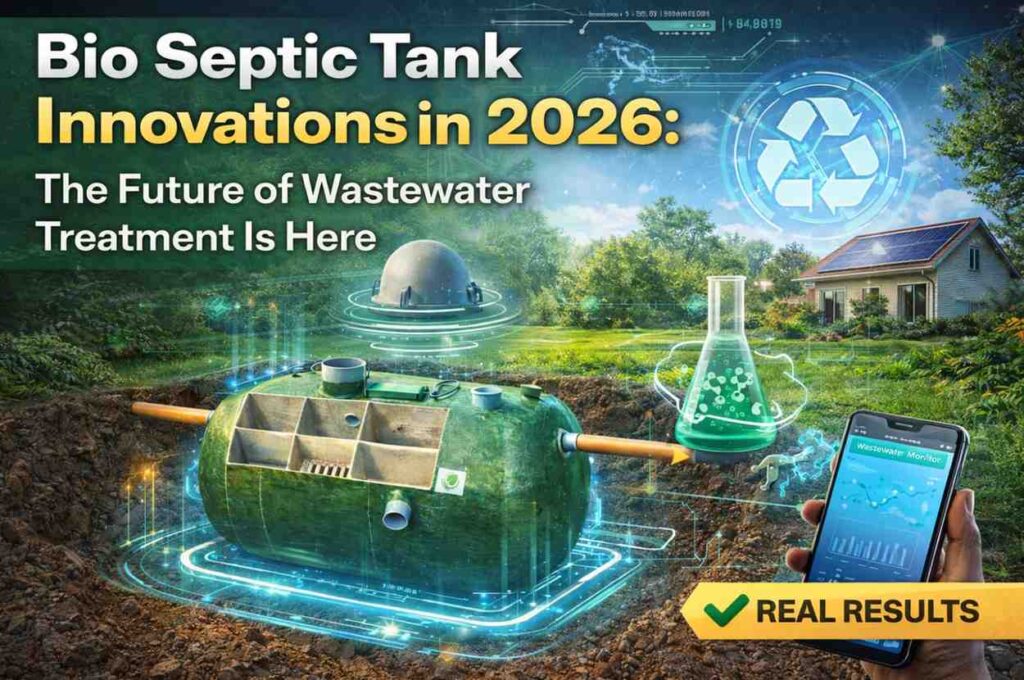
Something fundamental is shifting in wastewater treatment — and it’s happening quietly.
While the world debates artificial intelligence, electric vehicles, and renewable grids, another revolution is unfolding beneath our homes, apartments, schools, and commercial buildings. Bio septic tank innovations in 2026 are transforming on-site wastewater treatment into something smarter, cleaner, more efficient, and dramatically more resilient than ever before.
This isn’t incremental improvement.
It’s a structural upgrade to how decentralized sanitation works.
From smart IoT-enabled monitoring to membrane bioreactors compact enough to fit beneath a driveway, to energy-efficient aeration systems powered by solar panels — the bio septic systems of 2026 bear little resemblance to the passive anaerobic tanks of the past.
And the timing couldn’t be more critical.
Why 2026 Marks a Turning Point for Bio Septic Technology
The Global Wastewater Pressure
According to the World Health Organization, more than 3.6 billion people lack safely managed sanitation. Meanwhile, aging sewer infrastructure in developed nations is struggling to keep up with urban growth, climate stress, and rising environmental standards.
Centralized sewer systems were built for stability. But today’s reality includes:
Extreme rainfall events overwhelming combined sewer systems
Drought concentrating pollutants in discharge waterways
Rapid peri-urban development beyond sewer coverage
Tightening nutrient discharge regulations
The industry response is increasingly clear: decentralized wastewater treatment is no longer a backup plan. It’s becoming core infrastructure.
And bio septic systems are at the center of that shift.
The U.S. Environmental Protection Agency explicitly supports decentralized wastewater solutions as flexible, resilient, and cost-effective alternatives to centralized sewer expansion.
That endorsement matters.
The Convergence That Changed Everything
Bio septic systems didn’t leap forward overnight. They evolved.
Timeline of innovation acceleration:
1990s: Commercial aerobic treatment units (ATUs)
2010s: Early smart telemetry and membrane bioreactors
2020–2023: IoT cost reduction, modular prefabrication, digital monitoring maturity
2024–2026: Full convergence of biology, digital tech, energy efficiency, and regulatory alignment
What makes 2026 different is not a single breakthrough — it’s integration.
Smart monitoring + high-efficiency aeration + advanced biofilm media + nutrient removal + modular construction.
Together, they redefine what on-site treatment can achieve.
Innovation #1 — Smart Bio Septic Systems & IoT Integration
The most visible transformation in 2026 is digital.
A modern smart bio septic tank now continuously monitors:
Dissolved oxygen (DO)
Turbidity
pH
Flow rate
Blower performance
Sludge accumulation
Temperature
Instead of reacting to failure, systems predict it.
Predictive Maintenance in Action
Machine learning models now analyze vibration patterns and current draw to predict blower failure weeks in advance.
Results from large pilot deployments show:
70%+ reduction in emergency call-outs
40–50% energy savings via demand-responsive aeration
Dramatic compliance improvement
Smart systems no longer just alert you.
They diagnose and adjust automatically.
Innovation #2 — Advanced Biological Treatment Technologies
Next-Generation Biofilm Media
Modern MBBR (Moving Bed Biofilm Reactor) systems now achieve surface areas up to 1,200 m² per cubic meter — nearly double early designs.
This means:
Higher bacterial density
Greater BOD removal
Smaller tank footprints
BOD removal in 2026 systems commonly reaches 95–99%.
Membrane Bioreactors (MBR) at Residential Scale
Five years ago, MBR was a municipal technology.
In 2026, compact MBR systems deliver:
BOD below 5 mg/L
Near-zero TSS
Pathogen removal suitable for reuse
Membrane lifespan has doubled. Costs have dropped nearly 50%.
Effluent reuse is no longer theoretical.
It’s operational reality.
Innovation #3 — Compact & Modular Design
Land scarcity drives innovation.
Modern compact bio septic systems reduce footprint by up to 60% compared to 2015 equivalents.
Modular Expansion
Developers can now:
Install base capacity
Add modules as occupancy increases
Avoid overpaying for unused treatment capacity
This staged investment model reduces upfront capital burden significantly.
Below-Grade Installation
FRP (fiber-reinforced polymer) tanks allow:
Deep burial
Installation beneath parking lots
Corrosion resistance
50+ year lifespan
Aesthetic impact: zero.
Engineering sophistication: high.
Innovation #4 — Sustainable Materials & Green Manufacturing
Concrete dominated septic tanks for decades.
In 2026, alternatives include:
FRP composite tanks
Geopolymer concrete (low-carbon binder)
Corrosion-resistant internal coatings
Carbon footprint reduction for geopolymer concrete can reach 70% compared to traditional cement.
That matters for developers pursuing green certification.
Innovation #5 — Energy Efficiency & Solar Integration
Energy use has been cut nearly in half in many system types.
Why?
- Variable frequency drives
- Fine bubble diffusers
- Demand-responsive aeration algorithms
A residential ATU that consumed 2.0 kWh/m³ in 2020 now averages 1.0 kWh/m³ or less.
Solar Integration
In sun-rich regions, 1.5–2 kW solar arrays can fully power residential ATUs with battery backup.
For off-grid properties, this eliminates costly utility connections entirely.
Innovation #6 — Advanced Nutrient Removal
Nitrogen regulations are tightening globally.
2026 systems increasingly integrate:
- Biological Nutrient Removal (BNR)
- Anammox-based nitrogen reduction
- Zeolite ammonium capture
- Biochar drain field enhancement
Total nitrogen levels below 10 mg/L are now achievable at residential scale.
That was nearly impossible 10 years ago.
Innovation #7 — Water Reuse & Closed-Loop Systems
Effluent reuse is one of the most transformative trends.
MBR-treated water can now safely support:
Toilet flushing
Subsurface irrigation
Landscape watering
Groundwater recharge
For multi-unit buildings, wastewater recycling can reduce potable water demand by 25–40%.
In water-scarce regions, that’s game-changing.
Innovation #8 — Disinfection Technology Advances
LED UV Systems
Replacing mercury lamps, LED UV offers:
Instant startup
2–4× longer lifespan
Lower energy consumption
No hazardous disposal
Electrochemical Disinfection
Chemical-free systems generate disinfectant in-situ via electrolysis.
Ideal for remote or off-grid systems.
Innovation #9 — Regulatory Evolution
Regulations are shaping innovation as much as engineering.
Key trends:
Stricter nutrient limits
Effluent reuse standards
Mandatory smart monitoring in some jurisdictions
Expanded certification requirements
Systems now commonly require NSF certifications under updated standards.
Buyers must verify certifications directly via NSF International.
Innovation #10 — Climate Resilience & Global Applications
Flood-resistant design is now standard in vulnerable regions.
Features include:
Sealed access risers
Anti-flotation anchors
Waterproof electrical housings
Rapid-deploy containerized systems are now used for disaster relief and humanitarian response.
The International Water Association has emphasized decentralized systems as critical for climate resilience moving forward.
What to Look for in a 2026 Bio Septic System
If you’re buying today, prioritize:
Smart monitoring capability
Verified energy consumption data
Nutrient reduction performance
NSF certification
Local service network
Modular upgrade potential
Avoid systems relying solely on outdated passive anaerobic treatment unless your regulatory requirements are minimal.
Looking Toward 2030
The next four years are likely to deliver:
Energy-neutral wastewater systems
AI-optimized treatment automation
Commercial nutrient recovery (struvite)
Improved PFAS and micropollutant removal
Research into graphene membranes and synthetic microbial engineering continues, though widespread commercial deployment remains several years away.
Conclusion
The transformation of bio septic technology in 2026 is real.
Smaller. Smarter. Cleaner. More energy efficient. More resilient.
What was once a passive underground tank is now a monitored biological treatment system capable of delivering near-municipal performance at residential scale.
The technology is ready.
Regulations are aligning.
Investment is flowing.
And decentralized wastewater treatment is moving from alternative to mainstream infrastructure.
If your current system reflects 2015 engineering, it’s worth understanding what 2026 offers.
The wastewater revolution may be quiet — but it’s already underway.
FAQS
Many innovations such as smart IoT monitoring, LED UV disinfection, variable-speed blowers, and biochar drain field upgrades can be retrofitted to existing systems. However, advanced technologies like MBR units or full nutrient removal modules usually require system redesign or replacement.
Smart-enabled systems typically cost 10–25% more upfront than conventional units. However, reduced energy consumption, predictive maintenance, and fewer emergency repairs often offset this premium within 3–5 years.
Yes. Demand-responsive aeration, real-time monitoring, and improved biological media significantly lower emergency breakdowns and optimize service intervals, reducing annual maintenance costs over the system lifecycle.
Modern systems with Biological Nutrient Removal (BNR), Anammox processes, zeolite filters, and advanced polishing media can reduce total nitrogen below 10 mg/L and meet updated environmental standards in many regulated regions.
Solar-powered systems perform best in high-sun regions with battery backup. In moderate or low-sun climates, solar typically supplements grid power rather than fully replacing it. Proper sizing and energy storage design are critical for reliability.