
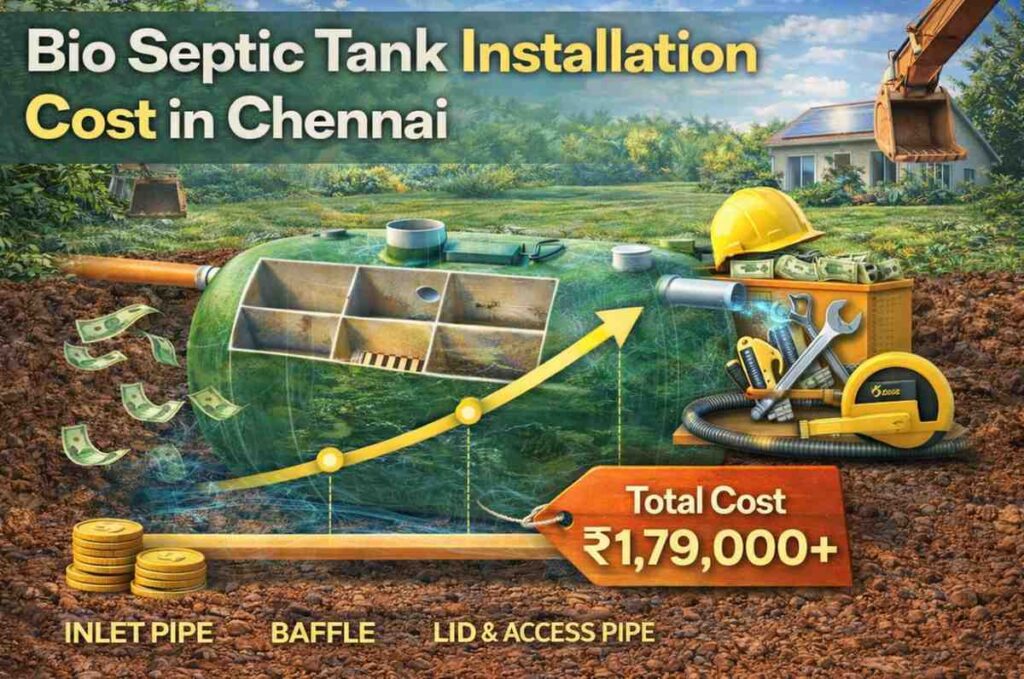
If you own a home in Chennai, you already know the city’s infrastructure throws a few curveballs. Drainage issues, waterlogging, overloaded sewage lines — it’s a familiar headache. And if your property isn’t connected to the main sewer network, the challenge gets even more personal. That’s exactly where a bio septic tank changes the game.
More and more Chennai homeowners, builders and housing societies are making the switch. Not just because it’s the cleaner option, but because — when you run the numbers — it’s the smarter financial decision too. This guide breaks down everything you need to know about bio septic tank installation cost in Chennai, from what it actually includes to where the hidden charges hide.
Whether you’re building from scratch, upgrading an aging concrete pit, or comparing options for an apartment complex — you’ll find a clear, honest answer here.
What Is a Bio Septic Tank?
A bio septic tank is an underground sewage treatment system that uses naturally occurring anaerobic bacteria to break down organic waste. Unlike a conventional septic tank — which simply holds waste until it’s pumped out — a bio septic tank actively digests that waste and converts it into harmless effluent water and trace gases.
The concept isn’t new. Biodigester technology has been used in agriculture and industrial settings for decades. What’s changed is how compact, affordable and accessible it’s become for residential use. Today, you can install a bio septic tank for a house in Chennai that handles a family of four, fits neatly under your garden, and requires virtually no maintenance for years.
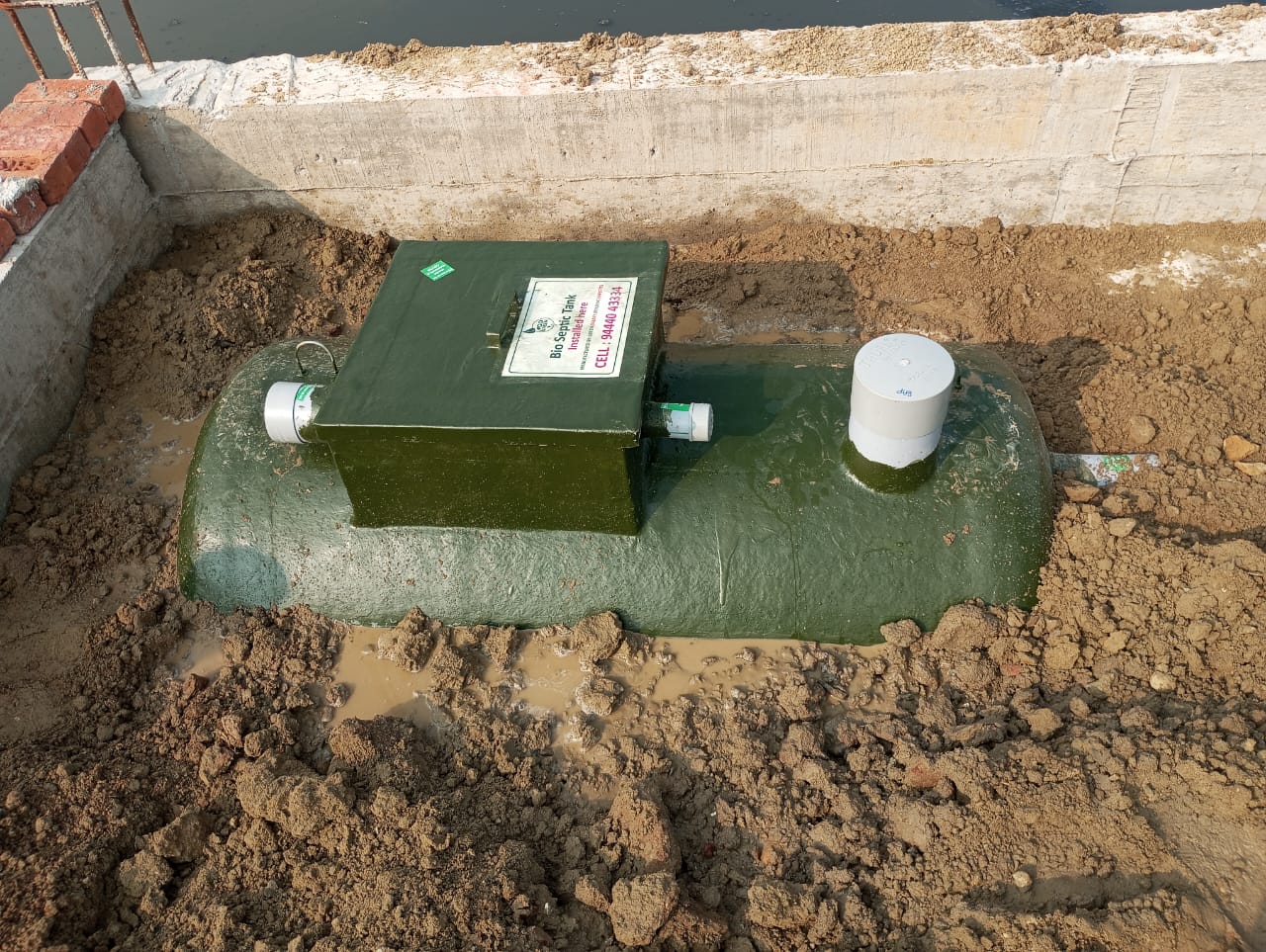
Key distinction: A bio septic tank doesn’t store waste — it eliminates it. That’s the fundamental difference between old and new.
The Indian market got a major boost when DRDO (Defence Research and Development Organisation) developed and released its own biodigester technology specifically for Indian conditions. Originally designed for army use in extreme terrains, DRDO’s bio digester technology found its way into the civilian market and has since become a benchmark for quality in this space.
In Chennai, these tanks are sold under various brand names — some licensed from DRDO, others independently engineered — but they all work on the same biological principle.
Is it legally approved in Chennai?
Yes. Bio septic tanks are fully compliant with:
-
CMDA (Chennai Metropolitan Development Authority) building regulations
-
TNPCB (Tamil Nadu Pollution Control Board) environmental standards
-
NGT (National Green Tribunal) directives on sustainable sanitation
-
Swachh Bharat Mission guidelines under the central government
In fact, the NGT has actively pushed for bio digester systems over conventional pits in urban areas — making this not just a lifestyle upgrade, but a future-proof compliance decision.
How a Bio Septic Tank Works
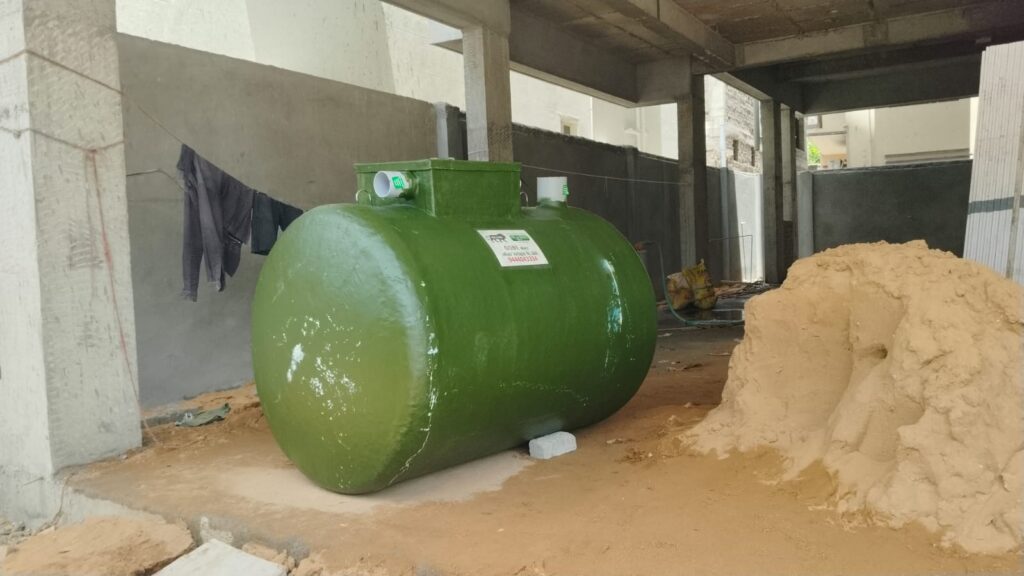
Understanding the working process helps you make better decisions about sizing, installation and maintenance. Don’t worry — this won’t get overly technical.
The Science of Bio Digestion
At its core, a bio septic tank works through anaerobic digestion. Here’s what that means in plain terms:
When organic waste enters the tank, it enters an oxygen-free environment populated by specific strains of bacteria. These microbes feed on the organic matter — breaking down fats, proteins and carbohydrates into simpler compounds. The result? Liquid effluent that’s largely harmless, small amounts of biogas (mostly methane and CO₂ that dissipate through vent pipes), and zero solid sludge buildup.
The process happens in stages:
Hydrolysis — Complex organic molecules are broken into simpler ones
Acidogenesis — Bacteria convert those simpler molecules into fatty acids
Acetogenesis — Fatty acids are converted into acetic acid, hydrogen and CO₂
Methanogenesis — Final bacteria convert these into methane and water
Each stage happens in sequence inside the tank chambers. The multi-chamber design — which better-quality bio tanks use — ensures waste passes through all stages before the effluent exits.
Single Chamber vs. Multi-Chamber Systems
Single chamber tanks are compact and affordable. They work well for small households (2–4 members) where wastewater volume is low and consistent.
Multi-chamber tanks are more thorough. Waste passes through two or three compartments, each with its own bacterial colony optimised for a specific stage of digestion. The effluent that exits is significantly cleaner. For larger homes, apartments and commercial properties, multi-chamber systems aren’t optional — they’re essential.
What Happens to the Effluent?
The treated liquid that exits the bio tank is low in pathogens and organic load. It flows into:
-
A soak pit — a gravel-filled underground pit that allows the effluent to percolate safely into the soil
-
A drainage field — a network of perforated pipes that distribute effluent across a wider soil area
-
In some cases, it can be used for garden irrigation after secondary treatment
This is a stark contrast to conventional tanks, where raw sewage either leaches into groundwater or has to be manually pumped out every 1–3 years.
Bio Septic Tank Price in Chennai
Here’s the headline figure most people come here for. Bio septic tank prices in Chennai in 2025 range from ₹25,000 to ₹2,50,000+ — and that spread isn’t arbitrary. It reflects genuine differences in size, material, brand and installation complexity.
Before diving into the detailed breakdown, here’s a quick-reference overview:
|
Tank Type |
Capacity |
Price Range (Supply Only) |
Installed Price Range |
|---|---|---|---|
|
FRP Bio Tank |
500L |
₹18,000 – ₹28,000 |
₹30,000 – ₹45,000 |
|
FRP Bio Tank |
1,000L |
₹35,000 – ₹55,000 |
₹50,000 – ₹80,000 |
|
RCC Bio Tank (site-built) |
2,000L |
₹60,000 – ₹90,000 |
₹85,000 – ₹1,30,000 |
|
HDPE Bio Tank |
500L |
₹15,000 – ₹22,000 |
₹25,000 – ₹40,000 |
|
DRDO-type Bio Digester |
1,000L |
₹45,000 – ₹70,000 |
₹65,000 – ₹1,00,000 |
|
Commercial Bio Tank |
5,000L+ |
₹1,20,000 – ₹1,80,000 |
₹1,50,000 – ₹2,50,000+ |
Two important distinctions to keep in mind:
-
Supply-only price is what you pay just for the tank unit — no installation
-
Installed price covers everything: tank, delivery, excavation, plumbing connections, bacterial culture and labour
Always ask which one you’re being quoted.
Average Bio Septic Tank Installation Cost in Chennai
The full septic tank installation cost in Chennai — when you factor in everything — tends to break down by property type:
Residential Installation Costs
1–2 BHK apartment or flat: ₹35,000 – ₹65,000 (500–750L FRP tank, standard soil conditions)
3–4 BHK independent house: ₹65,000 – ₹1,20,000 (1,000–1,500L tank)
Large villa or bungalow: ₹1,00,000 – ₹2,00,000+ (1,500–3,000L, often multi-chamber)
Commercial Installation Costs
Small office or retail space: ₹80,000 – ₹1,50,000
Apartment complex (20+ units): ₹1,50,000 – ₹3,50,000+
Hotels, schools, clinics: Custom quote — sizing is complex and site-dependent
What's Typically Included in the Installation Cost?
A proper all-in quote from a reputable Chennai installer should cover:
-
✅ Tank unit (FRP, RCC or HDPE as agreed)
-
✅ Delivery to site
-
✅ Excavation and pit preparation
-
✅ Inlet and outlet pipe connections
-
✅ Vent pipe installation
-
✅ Bacterial culture starter (inoculation)
-
✅ Basic soak pit construction
-
✅ Backfilling and surface restoration
-
✅ Labour charges
Hidden Costs Chennai Homeowners Often Miss
This is where budgets go sideways. Watch out for:
-
Soil testing fee: ₹1,500 – ₹5,000 if your site requires a percolation test
-
Rocky ground surcharge: Areas like Sholinganallur and Perungudi often have hard subsoil — machine excavation adds ₹5,000 – ₹15,000
-
Long pipe runs: If the tank location is far from the main bathroom lines, extra plumbing adds cost
-
Soak pit upgrade: Some sites need a larger or double soak pit — ₹8,000 – ₹20,000 extra
-
Permit fees: CMDA and local body approvals typically range ₹2,000 – ₹8,000 for residential
Location-Based Cost Variation Within Chennai
Where your property sits within Chennai genuinely affects what you’ll pay:
|
Area |
Cost Influence |
|---|---|
|
T. Nagar, Adyar, Anna Nagar |
Access difficulty, narrow lanes — 10–15% premium on labour |
|
Velachery, Tambaram, Chromepet |
Standard rates, good contractor availability |
|
ECR, OMR coastal belt |
Corrosion-resistant materials needed — adds ₹5,000 – ₹15,000 |
|
Avadi, Poonamallee, Ambattur |
Lower labour costs, wider plots, easier access |
|
Sholinganallur, Perungudi |
Rocky terrain common — excavation surcharge likely |
Factors Affecting Bio Septic Tank Installation Cost
Prices don’t vary randomly. Each variable has a logical explanation — and understanding them helps you avoid being overcharged or undersold.
Tank Capacity and Size
This is the single biggest cost driver. Tank size is determined by daily wastewater generation, which depends on:
-
Number of occupants
-
Usage patterns (how many bathrooms, kitchen wastewater included or not)
-
Whether servants’ quarters or rental units connect to the same system
Rough calculation:
Average person generates 100–150 litres of wastewater daily. Multiply by occupants, then factor in a retention time of 3–5 days for proper digestion. That gives you your minimum tank volume.
For example: 4 people × 120 litres × 4 days = 1,920 litres → round up to a 2,000L tank.
Undersizing is a costly mistake. A tank that’s too small for the load won’t fully digest waste, causing odor, overflow and early system failure. Always size up slightly, especially if you plan to expand.
Material Type (FRP / RCC / HDPE)
Each material has its own price point and performance profile:
|
Material |
Avg Cost Range |
Lifespan |
Weight |
Best Application |
|---|---|---|---|---|
|
FRP (Fibre Reinforced Plastic) |
₹₹ |
20–30 years |
Light |
Most residential Chennai use |
|
RCC (Reinforced Cement Concrete) |
₹₹₹ |
30–50 years |
Very heavy |
Large villas, commercial |
|
HDPE (High Density Polyethylene) |
₹ |
10–15 years |
Light |
Budget installations |
|
DRDO Bio Digester |
₹₹₹ |
25–50 years |
Medium |
Premium residential, military-grade |
FRP is the most popular choice for bio septic tank for house in Chennai — it strikes the right balance between cost, durability and ease of installation. It doesn’t rust, doesn’t crack under normal soil pressure, and is light enough to install without heavy equipment in most sites.
Excavation and Labour Cost
Labour in Chennai is priced by the job, not just by the hour. A standard residential installation typically costs:
-
Manual excavation (soft soil): ₹3,000 – ₹6,000
-
Machine excavation (hard/clay soil): ₹6,000 – ₹15,000
-
Installation labour (2-person team, 1–2 days): ₹4,000 – ₹10,000
-
Plumbing connections: ₹3,000 – ₹8,000 depending on pipe run length
Always ask for a day-rate breakdown, not just a lump sum. It makes comparing quotes far more accurate.
Transportation and Delivery Charges
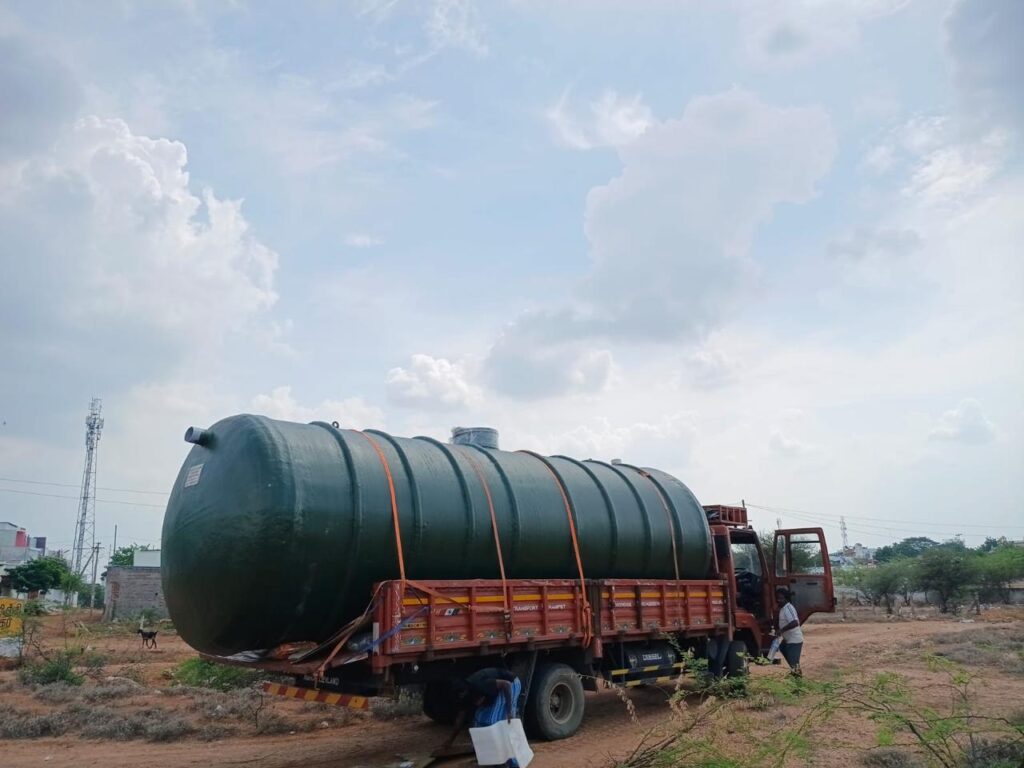
Large FRP tanks can’t fit in a standard pickup. They require flatbed vehicles or in some cases small cranes for oversized units. Delivery costs in Chennai typically range:
-
Within 15 km of supplier: ₹1,500 – ₹3,000
-
15–40 km radius: ₹3,000 – ₹6,000
-
Crane or special vehicle for 2,000L+ tanks: ₹5,000 – ₹12,000
To minimise delivery costs, choose a supplier with a warehouse or distribution point near your area. Several reputable dealers have depots in Ambattur, Perambur and Tambaram that serve different corridors of the city.
Installation and Plumbing Cost
Plumbing connections are where quality matters most. A poorly connected inlet pipe causes backflow. A vent pipe that’s too short or improperly placed causes odor. A misaligned outlet creates drainage failure months down the line.
Don’t let anyone cut corners on plumbing to save ₹2,000. It will cost you ten times that to fix later.
Typical plumbing cost breakdown:
-
Inlet connection from toilet/bathroom drain: ₹2,000 – ₹5,000
-
Outlet pipe to soak pit: ₹2,000 – ₹4,000
-
Vent pipe and cap: ₹1,000 – ₹2,500
-
Inspection chamber (optional but recommended): ₹2,000 – ₹4,000
FRP Bio Septic Tank Price in Chennai
FRP (Fibre Reinforced Plastic) tanks dominate the Chennai market — and for good reason. They’re manufactured off-site to precise tolerances, delivered ready to install, and perform consistently for 20+ years with minimal maintenance.
Here’s a detailed FRP bio septic tank price list for Chennai in 2025:
|
Capacity |
Approx. Dimensions |
Supply-Only Price |
Installed Price |
|---|---|---|---|
|
500 litres |
4ft × 3ft × 3ft |
₹18,000 – ₹28,000 |
₹30,000 – ₹45,000 |
|
750 litres |
5ft × 3ft × 3.5ft |
₹25,000 – ₹38,000 |
₹40,000 – ₹58,000 |
|
1,000 litres |
6ft × 3.5ft × 3.5ft |
₹35,000 – ₹55,000 |
₹52,000 – ₹80,000 |
|
1,500 litres |
7ft × 4ft × 4ft |
₹50,000 – ₹75,000 |
₹72,000 – ₹1,05,000 |
|
2,000 litres |
8ft × 4ft × 4ft |
₹65,000 – ₹95,000 |
₹88,000 – ₹1,30,000 |
|
3,000 litres |
10ft × 4.5ft × 4.5ft |
₹90,000 – ₹1,30,000 |
₹1,15,000 – ₹1,65,000 |
|
5,000 litres |
12ft × 5ft × 5ft |
₹1,20,000 – ₹1,70,000 |
₹1,50,000 – ₹2,20,000 |
What to check when buying an FRP bio septic tank in Chennai:
-
Wall thickness: Minimum 6–8mm for residential tanks. Thinner walls mean cheaper manufacturing, not cheaper installation costs — and they buckle under soil pressure.
-
Lamination quality: Look for isophthalic resin lamination, not ortho-phthalic. It’s more corrosion-resistant.
-
Inlet/outlet fitting type: Flanged fittings are stronger than threaded sockets for underground applications.
-
Manhole cover load rating: Should handle at least 250kg if installed under a driveway or parking area.
-
Warranty: Reputable brands offer 5–10 year structural warranties. Anything less deserves a closer look.
Bio Septic Tank Capacity Guide for Houses
Choosing the wrong tank size is the most common — and most expensive — mistake Chennai homeowners make. Too small and the system gets overwhelmed. Too large and you’re spending money unnecessarily on a tank whose bacterial colonies never reach optimal density.
Here’s how to get it right.
Bio Septic Tank Size for 2–4 Members
Recommended capacity: 500–750 litres
A family of two to four people generates roughly 200–480 litres of wastewater daily. With a 3–4 day retention time, a 500–750L tank provides sufficient capacity and contact time for full biological treatment.
This size suits:
-
1 and 2 BHK apartments
-
Small independent homes with a single bathroom
-
Urban plots in Chennai where space is limited
Estimated installed cost: ₹30,000 – ₹58,000
Pro tip: If you’re building a new home and plan to have children or elderly parents move in within the next 5 years, size up to 1,000L now. The cost difference is modest. The disruption of upgrading later is not.
Bio Septic Tank Size for 5–8 Members
Recommended capacity: 1,000–1,500 litres
A household of five to eight people is the most common scenario for larger Chennai homes — a nuclear family plus in-laws or domestic staff. Daily wastewater generation hits 500–960 litres, which demands a tank that can handle load spikes during mornings and weekends.
The 1,000–1,500L range is the sweet spot here. A two-chamber FRP tank at 1,000L or a single large-chamber at 1,500L both work well. The two-chamber option delivers cleaner effluent but costs slightly more.
Estimated installed cost: ₹52,000 – ₹1,05,000
Bio Septic Tank Size for Apartments and Commercial Buildings
Recommended capacity: 3,000L – 10,000L+ (or multiple tanks in parallel)
Sizing for apartments and commercial buildings requires a different calculation method:
Formula: (Number of users × 100L daily usage × 3-day retention) ÷ 0.75 (for 75% effective volume)
Example — 20-unit apartment, 3 members per flat: 60 people × 100L × 3 days ÷ 0.75 = 24,000 litres required capacity
At this scale, it’s often better to install two or three tanks in series or parallel rather than one enormous single tank. This approach offers redundancy — if one tank needs attention, the others continue working.
Commercial applications — hotels, schools, clinics — require additional consideration of peak load factors. A school cafeteria generates a very different wastewater profile than a residential building, even with the same user count.
Estimated installed cost for apartment complexes: ₹1,50,000 – ₹4,00,000+
Sizing Quick Reference:
|
Property Type |
Occupants |
Recommended Capacity |
Est. Installed Cost |
|---|---|---|---|
|
1–2 BHK Flat |
2–4 |
500–750L |
₹30,000 – ₹58,000 |
|
3–4 BHK Home |
4–6 |
1,000–1,500L |
₹52,000 – ₹1,05,000 |
|
Independent Villa |
6–10 |
1,500–2,500L |
₹85,000 – ₹1,50,000 |
|
Small Apartment (10 units) |
30–40 |
3,000–5,000L |
₹1,15,000 – ₹2,00,000 |
|
Large Apartment / Commercial |
50+ |
5,000L+ |
₹1,50,000 – ₹3,50,000+ |
Bio Septic Tank Installation Process
A quality installation is what separates a system that works flawlessly for 25 years from one that causes headaches within 18 months. Here’s exactly what the underground septic tank installation process looks like — step by step
Step 1 — Site Inspection
Before any digging starts, a thorough site inspection should happen. This isn’t just a formality. A good inspector will check:
-
Soil type and percolation rate — Clay-heavy Chennai soil absorbs effluent slowly; this affects soak pit design
-
Groundwater depth — Tank should sit at least 1–2 metres above the water table
-
Distance from structures — Minimum 3 metres from building foundations, 10 metres from borewells or open wells
-
Access for excavation equipment — Narrow plots in Anna Nagar or Mylapore may need manual digging only
-
Existing pipeline routing — To map the shortest, most logical inlet run from bathrooms to tank location
Any installer who skips this step and just asks for dimensions over the phone isn’t one you want working on your property.
Step 2 — Excavation and Base Preparation
The pit dimensions depend on the tank size plus working clearance. Typically:
-
Pit width: Tank width + 30–40cm on each side
-
Pit depth: Tank height + 20cm for gravel base + 10cm working clearance
-
Base layer: Compacted gravel or M10 concrete (10–15cm thick) — this prevents the tank from settling or tilting over time
In Chennai’s clay-dominant soil, proper base preparation is non-negotiable. Clay expands and contracts with moisture changes. A poorly prepared base can cause an FRP tank to shift, stressing the inlet and outlet connections until they crack.
Step 3 — Tank Placement and Connection
Once the pit is ready, the tank is lowered carefully — manually for smaller units, with a small crane for anything over 1,500L. Then:
-
Inlet pipe is connected from the main toilet/bathroom drain. The inlet should enter the tank above the liquid level to avoid backflow.
-
Outlet pipe runs from the tank’s discharge point to the soak pit or drainage field. A slight downward slope (1:60 minimum gradient) ensures gravity flow.
-
Vent pipe extends vertically from the tank lid to above roof level. This prevents methane buildup and eliminates the main source of odor.
-
Inspection chamber (strongly recommended) is placed at the inlet junction — a simple PVC box with a lid that allows you to check flow without digging.
Step 4 — Bacterial Seeding (Inoculation)
This is the step most people don’t know about — and it’s critical. A new bio tank is essentially a sterile vessel. It needs to be seeded with the correct bacterial cultures before it can start digesting waste.
The inoculation process involves:
-
Adding the bacterial culture packet (usually a liquid or powder concentrate) directly into the tank through the manhole
-
Adding 50–100 litres of water to create an initial liquid medium
-
Optionally adding a small amount of organic starter material (fermented cow dung or food waste) to kickstart the colony
The bacterial colony takes 2–4 weeks to fully establish at optimal digestion capacity. During this period:
-
✅ The tank can be used normally for waste input
-
❌ Don’t flush bleach, disinfectants or antibiotics — they kill the bacteria
-
❌ Don’t flush non-biodegradable materials
After 4 weeks, the system is operating at full capacity.
Step 5 — Final Testing and Backfilling
Before backfilling, a responsible installer will:
-
Run a water test — Fill the tank to operating level and check all connections for leaks
-
Verify outlet flow — Confirm gravity drainage to soak pit is working
-
Check vent pipe clearance — Ensure nothing obstructs the vent stack
-
Backfill in layers — Compact soil in 15–20cm lifts around the tank to prevent voids
What your installer should hand you at completion:
-
Tank warranty document
-
Bacterial culture brand and top-up schedule
-
Maintenance do’s and don’ts sheet
-
Invoice with itemised breakdown
-
CMDA compliance paperwork (if applicable)
Benefits of Installing a Bio Septic Tank
Why are so many Chennai homeowners making the switch to a bio digester septic tank? The reasons stack up quickly:
-
Zero odor. Properly installed bio tanks are odorless. The bacterial action eliminates the hydrogen sulfide compounds that cause conventional tanks to smell.
-
No desludging required. Ever. The bacteria consume the sludge continuously — there’s nothing to pump out.
-
Eco-friendly operation. The effluent output meets Indian environmental standards and doesn’t contaminate groundwater when routed through a proper soak pit.
-
Long lifespan. FRP tanks last 20–30 years. RCC and DRDO bio digesters can last 40–50 years with minimal intervention.
-
Low lifetime maintenance cost. An annual bacterial top-up of ₹500–₹2,000 is all most systems need.
-
Space efficient. Modern FRP bio tanks have a small footprint — a 1,000L unit is barely the size of a small car. It installs under gardens, driveways or parking areas without disrupting daily life.
-
Regulatory compliance. Fully approved under CMDA, TNPCB and NGT guidelines — future-proofing your property against tightening regulations.
-
Property value. Buyers and tenants in Chennai are increasingly aware of — and willing to pay a premium for — properties with proper modern sanitation systems.
Bio Septic Tank vs. Traditional Septic Tank
Still on the fence? Here’s the honest side-by-side comparison:
|
Feature |
Bio Septic Tank |
Traditional Septic Tank |
|---|---|---|
|
Odor |
Near zero |
Significant — especially in summer |
|
Maintenance |
Minimal (annual bacterial top-up) |
Desludging every 1–3 years |
|
Desludging cost |
Not required |
₹5,000 – ₹15,000 per event |
|
Lifespan |
20–50 years |
10–15 years (concrete deteriorates) |
|
Environmental impact |
Low — treated effluent output |
High — raw sewage leaching risk |
|
Installation cost |
Moderate to high |
Low to moderate |
|
10-year total cost |
Lower overall |
Higher due to maintenance |
|
Legal compliance (Chennai) |
Fully compliant |
Increasingly restricted |
|
Groundwater risk |
Minimal |
Significant in high water table areas |
|
Space required |
Compact |
Often requires larger footprint |
The numbers tell a clear story. A conventional tank might cost ₹20,000–₹40,000 to install, but add in three desludging events over 10 years (₹10,000–₹15,000 each) plus repair costs as the concrete degrades — you’re looking at ₹1,00,000+ in real costs. A bio septic tank installed for ₹65,000 with ₹15,000 in maintenance over the same period costs less overall — and never stinks up your garden.
Maintenance Cost of Bio Septic Tanks
One of the biggest selling points of a bio digester tank is how little it costs to maintain. But “low maintenance” doesn’t mean “no maintenance.” Here’s the honest breakdown.
Annual Maintenance Expenses
-
Bacterial culture top-up: ₹500 – ₹2,000/year (recommended once every 12–24 months, or after any accidental chemical flush)
-
Annual inspection by a technician: ₹1,000 – ₹3,000 (optional but smart for the first 3 years)
-
Vent pipe and outlet check: DIY possible — no cost beyond your time
-
Soak pit maintenance: ₹2,000 – ₹5,000 every 5–7 years to clear accumulated fine material
Total realistic annual cost: ₹1,500 – ₹5,000 — dramatically less than the ₹8,000–₹20,000 that conventional tank owners spend on average.
10-Year Total Cost of Ownership Comparison
|
Cost Item |
Bio Septic Tank |
Traditional Septic Tank |
|---|---|---|
|
Installation |
₹50,000 – ₹1,30,000 |
₹20,000 – ₹60,000 |
|
Annual maintenance (×10) |
₹15,000 – ₹50,000 |
₹80,000 – ₹2,00,000 |
|
Desludging events (3 times) |
₹0 |
₹15,000 – ₹45,000 |
|
Repairs and structural fixes |
Minimal |
₹10,000 – ₹30,000 |
|
10-Year Total (estimate) |
₹65,000 – ₹1,80,000 |
₹1,25,000 – ₹3,35,000 |
The conventional tank’s lower upfront cost evaporates completely within 4–5 years. After that, the bio tank is actively saving you money every year.
Signs Your Bio Septic Tank Needs Attention
Catch problems early. Watch for:
-
Slow drainage from toilets or bathroom floor drains
-
Gurgling sounds in the plumbing, especially after flushing
-
Odor returning after a previously odor-free period
-
Waterlogging near the soak pit area or outlet zone
-
Unusually lush patches of grass directly above the tank — can indicate leakage
What Kills the Bacteria in Your Bio Septic Tank?
This is the most preventable cause of bio tank failure. Keep these away from your drains:
-
Household bleach and strong disinfectants
-
Antibacterial handwash used in excessive quantities
-
Antibiotic medication residues (minor amounts are fine; concentrated doses are not)
-
Flushed wet wipes, sanitary products or paper towels
-
Paint, solvents or motor oil
If bacterial die-off occurs, the solution is simple: re-inoculate with a fresh bacterial culture. The system recovers within 2–3 weeks.
How to Choose the Best Bio Septic Tank in Chennai
With dozens of suppliers in the market — ranging from reputable manufacturers to fly-by-night operators — choosing wisely matters enormously. Here’s your practical checklist.
Key Factors to Evaluate
-
Correct capacity for your actual household size (not what the salesperson suggests)
-
Material quality — FRP wall thickness, resin grade, fitting type
-
Brand reputation and availability of after-sales service in Chennai
-
Installer credentials — CMDA-registered, experienced with Chennai soil conditions
-
Warranty terms — Both on the tank unit and the installation workmanship
Questions to Ask Your Installer Before Signing
Don’t let anyone start digging until you have clear answers to these:
- Are you registered with CMDA or any local body?
- What bacterial culture brand do you use, and how long does inoculation take?
- What exactly does your warranty cover — and for how long?
- Do you handle all permits and paperwork, or is that on me?
- Can you share contacts for two or three recent installations in Chennai?
- What’s your process if there’s a problem in the first 12 months?
Red Flags to Walk Away From
-
Quote given without any site inspection
-
Significantly lower price than every other quote you received
-
Resistance to providing a written, itemised invoice
-
No warranty documentation offered
-
Cash-only with no receipt
-
Inability to name the bacterial culture brand they use
Government Subsidies and Incentives in Chennai
Swachh Bharat Mission (Grameen and Urban) provides subsidies for sanitation infrastructure. While the primary focus has been on toilet construction, bio digester systems qualify under certain rural and peri-urban schemes.
Tamil Nadu’s TNUIFSL (Tamil Nadu Urban Infrastructure Financial Services Limited) and local municipal bodies periodically run sanitation upgrade schemes. Check with your local corporation office or panchayat for current availability.
Documents typically required for approval or subsidy:
-
Property ownership proof (patta or sale deed)
-
Building plan approval copy
-
Aadhaar and PAN of applicant
-
Site photographs
-
Contractor installation quote
Best Bio Septic Tank Dealers and Manufacturers in Chennai
Chennai has a healthy supply ecosystem for bio septic tanks — but quality varies significantly. Here’s how to navigate it.
What to Look for in a Chennai Supplier
-
Local manufacturing or warehousing — avoids long delivery waits and inflated transport costs
-
Certified installer team — not just a sales outfit that outsources installation to unknown contractors
-
After-sales support — responsive to calls if something needs fixing post-installation
-
Track record — can show you completed installations and willing customer references
Top Bio Septic Tank Brands Available in Chennai
Several established names operate in the Tamil Nadu market:
-
Sintex Industries — One of India’s largest plastic tank manufacturers; wide distribution in Tamil Nadu
-
Bioxer — Specialises in bio digester systems; strong dealer network in Chennai
-
Supreme Industries — Known for consistent FRP quality; available through dealers across the city
-
Local Tamil Nadu manufacturers — Often offer competitive pricing and faster delivery; quality varies, so inspect samples before committing
When evaluating local manufacturers, visit their factory or ask for a sample panel to check FRP thickness and resin quality. A reputable local maker is often a better choice than a national brand with a poor local installer network.
How to Get the Best Quote in Chennai
Get at least three quotes. Non-negotiable. The variance in Chennai can be ₹20,000–₹40,000 for the same tank and scope of work.
When comparing quotes, look at the itemised breakdown, not just the total:
-
Is the tank brand specified by name and model?
-
Is excavation included or extra?
-
Is the bacterial culture cost included?
-
What’s the warranty period for labour?
Negotiate on labour, not on tank quality. A contractor who’s willing to shave ₹5,000 off by using a thinner FRP tank isn’t doing you a favour. A contractor who reduces labour margin to win a fair job is.
Off-peak seasons (January–February, before the summer rush) sometimes yield better pricing as demand dips.
Real Cost Case Studies — Chennai Homeowners
Case Study 1: 2 BHK Apartment, Velachery
Situation: A young couple in a ground-floor apartment on a 600 sq ft plot. No connection to the main sewer line. Existing pit was overflowing every rainy season.
Solution: 750L single-chamber FRP bio septic tank, connected to both bathrooms. Standard soil conditions. Soak pit included.
Total Cost: ₹42,500
-
Tank (750L FRP): ₹27,000
-
Excavation and base prep: ₹4,500
-
Plumbing connections: ₹5,000
-
Soak pit: ₹4,000
-
Bacterial culture: ₹2,000
Result: Zero odor complaints since installation 18 months ago. No maintenance costs yet.
Case Study 2: Independent Villa, East Coast Road (ECR)
Situation: A 4-bedroom villa near the coast, high water table, approximately 8 occupants including domestic staff. Previous conventional tank needed desludging twice in 3 years.
Solution: 2,000L two-chamber FRP bio tank with corrosion-resistant fittings. Larger soak pit with gravel drainage field due to coastal soil.
Total Cost: ₹1,14,000
-
Tank (2,000L FRP, coastal grade): ₹72,000
-
Machine excavation (hard soil): ₹12,000
-
Corrosion-resistant pipe fittings: ₹8,000
-
Expanded soak pit and drainage field: ₹15,000
-
Bacterial inoculation and setup: ₹7,000
Result: No desludging needed in 2+ years. Estimated annual savings: ₹12,000–₹15,000 vs. old system maintenance costs.
Case Study 3: Small Commercial Space, Anna Nagar
Situation: A ground-floor clinic with 15 staff and approximately 60 patient visits daily. Existing municipal connection was inadequate during peak hours.
Solution: 3,000L commercial-grade RCC bio tank with two-stage treatment and inspection chamber. Three-day installation.
Total Cost: ₹98,000
-
RCC tank construction and lining: ₹58,000
-
Excavation and base (manual, narrow lane access): ₹14,000
-
Two-stage treatment fittings: ₹12,000
-
Inspection chambers ×2: ₹8,000
-
Permits and documentation: ₹6,000
Result: Clinic director reports zero sewage issues in 14 months. System handles peak morning load without any overflow.
Conclusion
The decision to install a bio septic tank in Chennai isn’t just about solving a sanitation problem. It’s an investment — in your comfort, your property value and the environment your family lives in.
Yes, the upfront bio septic tank installation cost in Chennai is higher than a conventional pit. But the math over 5–10 years is unambiguous. Lower maintenance, zero desludging, no odor, full regulatory compliance — the bio septic system wins on every dimension that actually matters over time.
The key takeaways from this guide:
FRP bio tanks priced ₹30,000–₹80,000 (installed) suit most Chennai residential needs
Always size your tank for future household growth, not just current occupancy
Get at least three itemised quotes before committing
Choose installers who do a proper site inspection before quoting
Never compromise on plumbing connection quality — it’s where most problems start
The full 10-year cost of a bio tank is consistently lower than a conventional system
Whether you’re a first-time homeowner in Tambaram, a developer building in OMR or a facility manager in Anna Nagar — the bio septic tank for house in Chennai is the sewage treatment system that makes long-term sense.
Get a site inspection from a certified Chennai installer. Ask the right questions. Invest in quality once — and forget about it for the next two decades.
FAQS
FRP tanks typically last 20–30 years. RCC and DRDO bio digesters can last 30–50 years with minimal maintenance. The bacterial system itself has an indefinite lifespan as long as it's not poisoned by harsh chemicals.
No — when properly installed with a correctly routed vent pipe, a bio septic tank is essentially odorless. Odor only occurs if the vent is blocked, the bacterial culture dies, or the tank is severely overloaded.
Yes, if the apartment has a ground-floor plot or basement access. Several Chennai apartment complexes use shared bio tanks installed in the compound. Individual flat installation is possible only if there's accessible ground space.
The treated effluent from a well-functioning bio tank is low in pathogens and can be used for garden irrigation, especially for non-food plants. For edible crop use, secondary treatment through a sand filter is recommended.
t doesn't. That's the point. In a properly functioning bio septic tank, bacterial action continuously digests the waste. There's no solid sludge accumulation to remove.
The tank temporarily reverts to a passive holding tank. You may notice odor and slower drainage. The fix is simple — re-inoculate with a fresh bacterial culture (₹500–₹2,000) and the system recovers within 2–3 weeks.
Yes. Bio septic tanks comply with CMDA and Greater Chennai Corporation guidelines. Certain zones may require advance approval — check with your local ward office.
For single homes and small buildings, a bio septic tank is almost always the better choice — lower cost, simpler operation, no skilled operator required. STPs are more appropriate for large apartment complexes (100+ units) or commercial properties with high wastewater volumes.
Subsidies are available under Swachh Bharat Mission for eligible properties, particularly in rural and peri-urban areas. Urban Chennai residents should check with their local corporation or TNUIFSL for current schemes.
A 1,000–1,200 litre tank is the recommended size for a family of 5 in typical Chennai conditions. If the family includes elderly members or generates higher wastewater volume (e.g., washing machine directly connected), size up to 1,500L.