
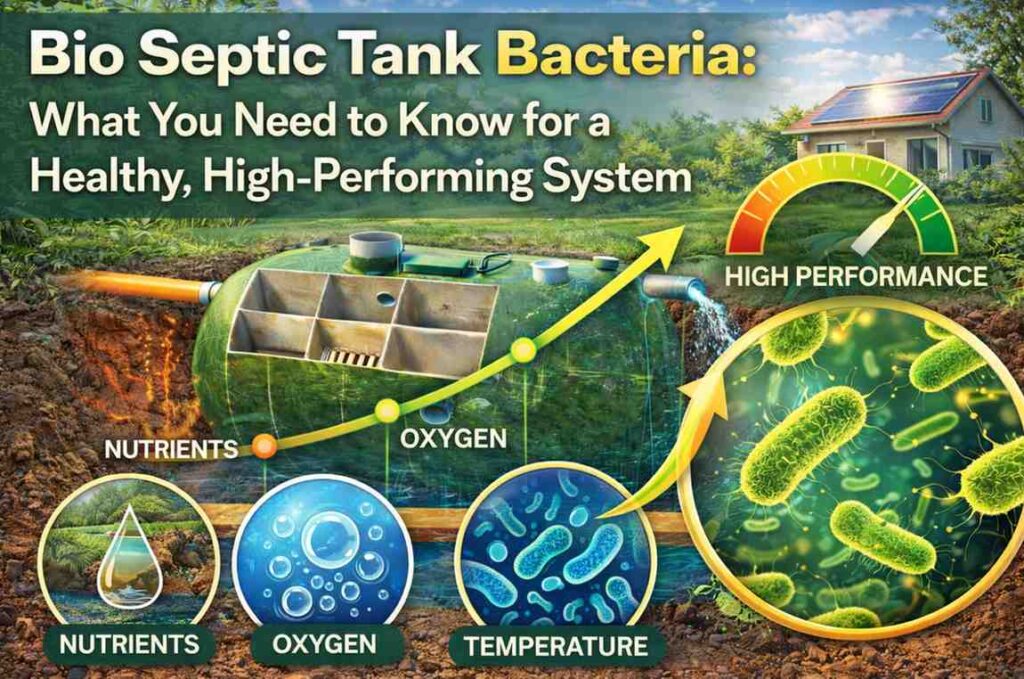
Most homeowners spend lakhs installing a bio septic system and then treat it like a passive utility — something buried underground that will somehow “just work.” That assumption is where expensive problems begin. Because unlike a pipe or pump, your bio septic tank is a living biological reactor.
The real engine behind every flush, every shower, every litre of wastewater your household produces isn’t mechanical. It’s microbial.
Bio septic tank bacteria are the invisible workforce converting raw sewage into safer, cleaner effluent. They digest organic waste, reduce sludge, suppress odours, eliminate pathogens, and protect your drain field and groundwater. When they’re healthy, your system runs quietly for decades. When they’re stressed or destroyed, performance collapses quickly — and repairs become costly.
This expanded guide explains exactly how septic bacteria work, what supports them, what harms them, how to restore them after disruption, and how to keep your system biologically balanced long-term.
The Living Engine Inside Your Bio Septic Tank
Strip away the engineering terminology and what you have is a managed ecosystem. A bio septic tank is designed to create ideal conditions for billions of microorganisms — primarily bacteria — to thrive and process waste continuously.
Strip away the engineering terminology and what you have is a managed ecosystem. A bio septic tank is designed to create ideal conditions for billions of microorganisms — primarily bacteria — to thrive and process waste continuously.
These microorganisms consume proteins, fats, carbohydrates, and organic solids. Through biological reactions, they convert complex waste into simpler compounds, gases, and stabilised solids. A mature bacterial community can reduce biological oxygen demand (BOD) by up to 90% or more in well-functioning aerobic systems.
When this ecosystem is stable:
Odours remain minimal
Sludge accumulates slowly
Drain field loading is reduced
Effluent quality improves
When it’s disrupted:
Odours increase
Sludge builds faster
Drains slow
Effluent quality declines
Drain field clogging accelerates
Understanding how septic tank bacteria work is the single most important factor in protecting your investment.
The Types of Bacteria Working in Your System
A healthy septic system isn’t powered by one type of bacteria. It’s a coordinated biological community.
1. Aerobic Bacteria — The High-Performance Workforce
Aerobic bacteria require oxygen. In aerobic bio septic systems, an aerator pump continuously supplies air, allowing these bacteria to dominate the treatment zone.
Their advantages:
Faster organic breakdown
Higher pathogen reduction
Lower odour production
Reduced sludge formation
Aerobic bacteria convert waste primarily into carbon dioxide and water — which is why aerobic systems produce less smell compared to anaerobic systems.
However, they depend on oxygen supply. If the aerator fails, aerobic populations decline quickly.
2. Anaerobic Bacteria — The Sludge Digesters
Anaerobic bacteria operate without oxygen. They dominate the sludge layer at the bottom of the tank.
Their primary roles:
Breaking down settled solids
Reducing sludge volume
Producing biogas (methane and CO₂)
They work slower than aerobic bacteria but are essential for long-term sludge management.
3. Facultative Bacteria — The System Stabilizers
Facultative bacteria can function with or without oxygen. They act as biological stabilizers during transition periods — such as hydraulic shock or mild chemical exposure.
They help maintain baseline treatment performance while specialist communities recover.
4. Beyond Bacteria — The Supporting Microbial Cast
Your septic tank also contains:
Archaea (methane producers)
Protozoa (pathogen grazers)
Fungi (break down resistant compounds)
Together, this microbial ecosystem forms a self-regulating treatment system.
How Bio Septic Tank Bacteria Break Down Waste
The treatment process happens in biological stages:
Stage 1: Hydrolysis
Complex waste (proteins, fats, carbohydrates) is broken into simpler soluble compounds by enzymes. This is the rate-limiting step of treatment.
Too much grease or oil slows hydrolysis dramatically.
Stage 2: Acidogenesis
Simple compounds are converted into volatile fatty acids and gases.
Stage 3: Acetogenesis
Volatile acids are transformed into acetate and hydrogen — preparing substrates for final-stage bacteria.
Stage 4: Final Oxidation or Methanogenesis
In aerobic systems → organic matter is mineralised into CO₂ and water.
In anaerobic systems → methane is produced.
This staged process only works when bacterial balance is intact.
What Do Septic Tank Bacteria Eat?
They feed on organic waste:
Human waste
Food particles
Toilet paper
Biodegradable soaps
They do not effectively break down:
Plastics
Wipes
Sanitary products
Synthetic fibres
Large grease volumes
Chemical disinfectants
Garbage disposals significantly increase organic load and stress bacterial communities.
What Kills Bio Septic Tank Bacteria?
The biggest threat isn’t system failure. It’s household habits.
1. Bleach and Chlorine Cleaners
Bleach kills bacteria by design. Even moderate regular use suppresses aerobic bacterial populations.
Switch to septic-safe cleaners immediately.
2. Chemical Drain Cleaners
These can collapse bacterial populations in a single event. Avoid completely.
Use enzyme-based drain treatments instead.
3. Antibacterial Soaps
Daily use creates cumulative suppression. Standard soap is sufficient for hygiene.
4. Antibiotics
Antibiotics are excreted in urine and faeces. They suppress septic bacteria for weeks.
After a household antibiotic course:
Avoid chemical cleaners
Consider bacterial reseeding
5. Hydraulic Shock
Multiple laundry loads, heavy water usage, or stormwater infiltration can wash bacteria out of the treatment zone.
Spread water usage across the day.
6. Extreme Temperatures
Optimal bacterial performance: 20°C–37°C.
Cold slows metabolism. Excess heat stresses aerobic populations.
Adequate soil cover helps regulate temperature.
Signs Your Septic Bacteria Are Unhealthy
Watch for early warnings:
Persistent odour
Slow drains across multiple fixtures
Gurgling sounds
Dark green patches over drain field
Effluent surfacing
These are bacterial health signals — not just plumbing issues.
Early action prevents major failure.
Do You Need to Add Bacteria Regularly?
In most cases: No.
A well-maintained system naturally sustains its bacterial population.
Additives are helpful in specific situations:
After new installation
After desludging
After chemical contamination
After antibiotic courses
After extended vacancy
Routine monthly dosing without reason is usually unnecessary.
Choosing a Quality Bacterial Treatment
If treatment is needed:
Look for multi-strain cultures
Minimum 1 billion CFU per dose
Check expiry date
Ensure proper storage
Yeast is not a substitute for septic bacteria.
Long-Term Bacterial Protection Checklist
Use non-antibacterial cleaning products
Never pour grease down drains
Spread water usage
Avoid garbage disposals
Inspect aerator every 6 months
Schedule annual professional inspection
Monitor sludge levels every 2 years
Keep maintenance records
These practices cost nothing — and save thousands over time.
Aerobic vs Anaerobic Performance Comparison
Parameter | Aerobic | Anaerobic |
|---|---|---|
BOD Removal | 85–98% | 50–70% |
Odour | Low | Higher |
Sludge Production | Lower | Higher |
Treatment Speed | Faster | Slower |
Energy Needed | Yes | No |
Aerobic systems outperform — but require proper aeration maintenance.
Indian Climate Considerations
India’s warm climate generally supports strong bacterial activity.
Challenges include:
Monsoon hydraulic overload
Groundwater rise
Summer heat stress
Ensure:
Proper tank sealing
Adequate soil cover
Drain field protection
Monsoon inspection is critical.
Biofilm — The Hidden Advantage
Beneficial bacteria form biofilm on tank surfaces. This:
Increases bacterial density
Protects bacteria from washout
Improves treatment stability
Biofilm in pipes can cause blockage — but biofilm in treatment chambers is beneficial.
Recovery Timelines
Minor disruption: 2–4 weeks
Moderate disruption: 4–8 weeks
Severe disruption: 8–16 weeks
Bacterial seeding shortens recovery by 30–50%.
Final Verdict — Protect the Biology
Everything about your bio septic system — performance, longevity, odour control, maintenance cost — depends on bacterial health.
Five truths every owner must remember:
Bacteria are the treatment system.
Chemicals are the primary threat.
Household behaviour determines system lifespan.
Additives help only after disruption.
Early warning signs matter.
Protect the biology, and your system can function efficiently for 25+ years.
Ignore it, and repairs become inevitable.
Your bio septic tank isn’t just infrastructure. It’s a living ecosystem beneath your property. Treat it that way — and it will reward you with decades of silent, efficient performance.
FAQS
Yes. Bio septic tanks use beneficial bacteria to biologically treat wastewater before it enters the soil. This significantly reduces pollutants such as organic matter, suspended solids, and harmful pathogens compared to traditional septic systems, which mainly rely on sedimentation. As a result, bio septic tanks lower the risk of groundwater contamination, surface water pollution, and soil degradation.
Bio septic tanks reduce biological oxygen demand (BOD), pathogens, and organic waste before effluent reaches the drain field. Cleaner effluent allows natural soil filtration to work more effectively, decreasing the likelihood of nitrates, bacteria, and contaminants entering underground aquifers — which is critical in areas that rely on borewells or wells for drinking water.
All septic systems produce some greenhouse gases. Traditional anaerobic septic tanks can release methane (CH₄), a potent greenhouse gas. Aerobic bio septic systems, however, significantly reduce methane generation by using oxygen-based biological processes. While some systems consume electricity, overall climate impact is generally lower than poorly managed conventional systems.
In many cases, yes — if the system is properly designed and maintained. Bio septic tanks produce higher-quality effluent with lower pathogen levels, making it suitable for non-potable uses such as landscape irrigation or groundwater recharge (subject to local regulations). However, direct contact with edible crops should follow regional environmental guidelines.
Yes, many chemical septic cleaners contain acids, alkalis, or synthetic disinfectants that kill beneficial bacteria inside septic systems. This disrupts biological treatment, increases pollution risk, and may allow toxic residues to leach into soil and groundwater. Biological septic treatments are generally more environmentally friendly because they support natural microbial processes rather than destroy them.