
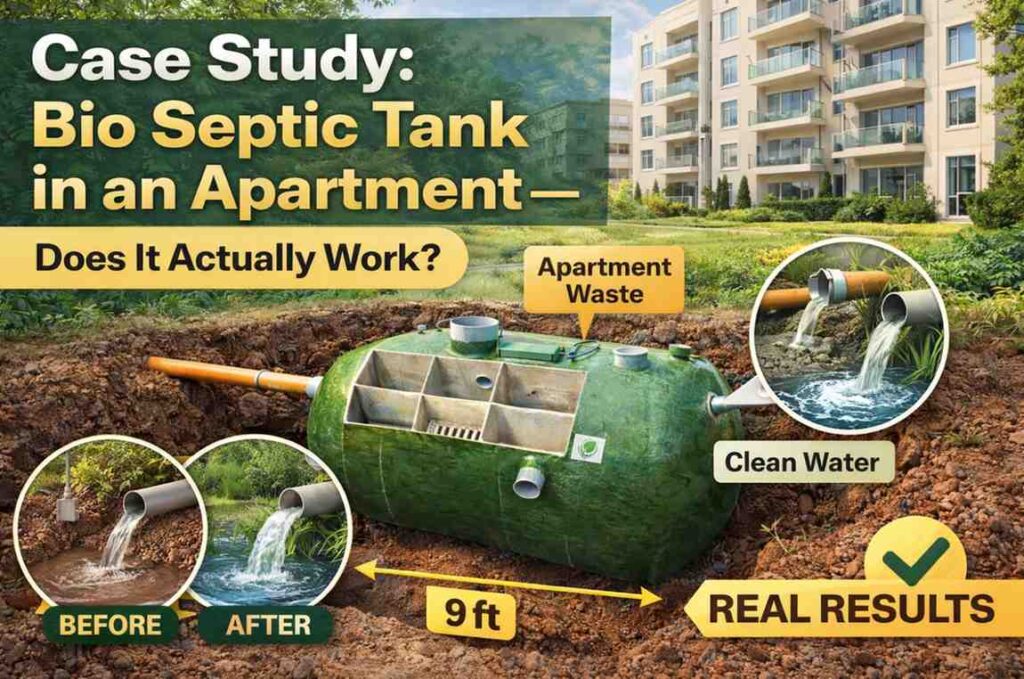
Picture this: a developer finishes a 16-unit apartment complex on the outskirts of a growing city. The building is modern, well-designed, and ready for tenants. There’s just one problem — the municipal sewer line is 800 meters away, and connecting to it will cost more than the landscaping budget, the parking lot, and the lobby renovation combined.
Sound familiar?
This is happening everywhere — especially in peri-urban growth corridors where infrastructure lags behind development. Developers face a choice: delay the project waiting for sewer expansion, absorb massive connection costs, or explore decentralized wastewater treatment.
Increasingly, the solution isn’t a conventional septic tank. It’s a bio septic tank — a biological wastewater treatment system engineered to handle higher loads with improved effluent quality.
But can it really handle an apartment building?
This case study answers that question with real-world data — installation experience, cost breakdown, performance metrics, regulatory challenges, and 12 months of operational results.
Why Consider a Bio Septic Tank for an Apartment Building?
The Infrastructure Gap
Municipal wastewater systems are expensive to expand. Sewer extensions for multi-unit properties frequently require:
Road trenching
Utility relocation
Lift stations
Capacity fees
Ongoing monthly sewer charges
In this case study, sewer connection was quoted at ₹39,01,000 upfront, plus approximately ₹17,82,000 annually in sewage fees.
That financial reality forces developers to evaluate alternatives — especially when on-site wastewater treatment for multi-unit buildings is now recognized by environmental authorities as viable and sustainable.
The U.S. Environmental Protection Agency supports decentralized wastewater treatment as a legitimate long-term infrastructure solution through its decentralized wastewater programs.
What Makes an Apartment Different From a House?
Scaling from a family home to a 16-unit building isn’t multiplication — it’s engineering.
1. Flow Volume
Single-family home: 150–300 gallons/day
16-unit building (32 residents avg.): ~3,200 gallons/day
2. Peak Hydraulic Surge
Morning and evening demand spikes can be 2–3× average flow.
Without buffering capacity, surge flow reduces hydraulic retention time (HRT), undermining biological treatment.
3. Load Variability
Apartments introduce:
Laundry detergents
Cleaning chemicals
Personal care products
Occasional medication residues
All of which affect biological stability.
4. Space Constraints
Drain fields, tanks, and mechanical components must fit within tight site boundaries.
These realities require design enhancements beyond standard residential systems.
System Design Chosen for This Project
After soil testing and regulatory consultation, engineers selected:
2,500-gallon equalization tank
Enhanced Aerobic Treatment Unit (ATU)
Fine bubble aeration system
Clarifier chamber
Effluent filter
UV disinfection unit
Mound absorption field
Remote telemetry monitoring
The equalization tank was critical. It absorbed peak morning flow and released wastewater to the treatment chamber gradually — protecting biological efficiency.
Without it, performance would have fluctuated dramatically.
The Installation Process
Weeks 1–2: Site Preparation
Stormwater line relocation
Excavation using compact machinery
Soil stabilization for tank base
Week 3: Tank Placement
Both tanks were craned into position. Precision leveling was essential to maintain internal flow balance.
Week 4: Drainage Integration
Four building stacks were rerouted into a unified main line feeding the equalization tank.
Work was scheduled unit-by-unit to minimize resident disruption.
Week 5: Electrical & Mechanical Setup
A licensed electrician installed:
Blower system
Transfer pump
UV unit
Telemetry panel
Noise insulation was added to the blower housing.
Week 6: Drain Field Construction
- Compacted sand base
- Perforated distribution piping
- Gravel bedding
- Geotextile fabric
- Soil mound graded for runoff
Week 7: Commissioning
System was seeded with bacterial starter culture and operated on reduced load for 14 days before full wastewater introduction.
Total installation time: 7 weeks
Performance Data After 12 Months
Wastewater Quality Results
Parameter | 12-Month Average | Regulatory Standard |
|---|---|---|
BOD | 18–26 mg/L | <30 mg/L |
COD | 40–58 mg/L | <100 mg/L |
TSS | 10–18 mg/L | <30 mg/L |
Fecal Coliform | <80 CFU/100mL | <200 CFU/100mL |
BOD reduction averaged 92%.
For comparison, conventional septic systems often discharge effluent above 150 mg/L BOD.
Seasonal Variation
Winter temperatures slightly reduced efficiency, but adjusting equalization timing restored optimal performance.
Remote telemetry allowed quick response before compliance thresholds were breached.
Maintenance & Reliability
Unplanned Maintenance (Year 1)
Minor pump blockage (wipes) — ₹14,940
Two air filter cleanings
One UV lamp replacement
Total unexpected cost: ₹35,275
Planned Maintenance
Annual service contract — ₹1,49,400
Total Annual Operating Cost
Item | Cost (INR) |
|---|---|
Electricity | ₹94,620 |
Service Contract | ₹1,49,400 |
Pump-out (annualized) | ₹39,840 |
Compliance Testing | ₹49,800 |
Consumables | ₹34,860 |
Total | ₹3,68,520 per year |
Per Unit Cost
₹1,909 per apartment per month
Municipal Sewer Equivalent
Approximately ₹9,296 per unit per month
Resident Experience
Initial concern: odor.
After month 2: zero complaints.
Aerobic treatment produces significantly less hydrogen sulfide than anaerobic systems. Venting above roofline eliminated detectable odors.
A tenant survey showed:
100% reported no inconvenience
100% would recommend the building
Unexpected outcome: sustainability became a marketing advantage.
Financial Comparison
Bio Septic System
Installation: ₹53,70,100
Annual operating: ₹3,68,520
10-year cost: ~₹90,55,300
Municipal Sewer
Connection: ₹39,01,000
Annual fees: ₹17,92,800
10-year cost: ~₹2,18,29,000
Savings Over 10 Years
~₹1,27,73,700
Even with installation overruns, decentralized treatment delivered significant financial benefit.
Regulatory Lessons
Multi-unit systems face stricter review than single homes.
Approvals required:
Soil evaluation
Environmental review
Installation permit
Electrical permit
Effluent discharge approval
Ongoing monitoring plan
Permit timeline in this case: 7 months
Lesson: Start regulatory engagement early.
Key Takeaways
What Worked
Equalization tank prevented surge overload
Telemetry avoided compliance failures
Clear resident education prevented repeat blockages
Local service contractor reduced downtime
What Could Improve
Budget 30–40% contingency
Anticipate permit delays
Install temporary fencing around new drain fields
When Bio Septic Systems Work Best for Apartments
Peri-urban developments
Sewer connection cost is high
4–30 unit buildings
Moderate available land
When They’re Less Suitable
High-density towers
Commercial kitchens onsite
Very strict nitrogen discharge requirements
Extremely constrained land area
Final Verdict — Does It Actually Work?
After 12 months of operation, the answer is clear:
Yes.
The bio septic tank met all effluent standards, operated reliably, generated minimal complaints, and delivered substantial financial savings compared to sewer connection.
But it is not a casual installation.
It requires:
Careful engineering
Conservative budgeting
Early regulatory engagement
Professional maintenance
Resident education
When those pieces are in place, a bio septic tank in an apartment building is not just viable — it’s strategically smart.
As decentralized wastewater technology improves and sewer infrastructure costs rise, systems like this will likely become the default solution in many expanding urban zones.
For developers willing to plan properly, the long-term economics and environmental benefits make a compelling case.
FAQS
A properly engineered and maintained bio septic system serving a multi-unit building can last 20–30 years, with mechanical components (blowers, pumps, UV units) typically requiring replacement every 5–10 years. The drain field lifespan depends heavily on soil conditions and loading rates. Regular desludging and monitoring significantly extend system life.
Yes — but only if designed with equalization capacity or surge buffering. Apartment buildings experience short periods of high flow that can overwhelm undersized systems. Properly sized equalization tanks and hydraulic retention time calculations ensure the biological process remains stable even during peak usage.
Misuse can cause:
Pump blockages
Reduced biological efficiency
Increased sludge buildup
Temporary compliance issues
However, most problems are reversible with prompt maintenance. The key is resident education and routine monitoring. Buildings with posted usage guidelines experience far fewer operational disruptions.
Generally no — provided the system is:
Fully permitted
Professionally engineered
Properly maintained
Documented with compliance reports
In fact, documented wastewater compliance can reduce environmental liability risk compared to aging conventional septic systems or informal drainage solutions.
When properly installed and compliant with effluent discharge standards, bio septic systems significantly reduce BOD, TSS, and pathogens before effluent reaches soil. Systems that include UV disinfection and monitored treatment performance provide strong groundwater protection — often safer than poorly maintained conventional septic tanks.